
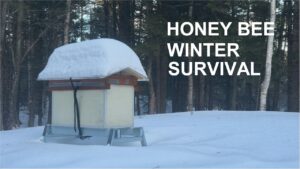
Here we have very cold winters.
The gold standard of wintering in climates with cold winters is what honey bees themselves have relied upon for thousands of years – a well insulated bee nest in a natural tree hollow.
A Beehive that closely mimics a natural tree hollow that bees tend to choose for their nest, would favor the bees rather than a beekeeper.
Here, Tom Seeley—a renowned honey bee researcher—shows the inner dimensions of the natural tree hollow that bees prefer: roughly a 10-gallon (40-liter) cavity with very thick side walls and exceptionally thick insulation above the cluster.
There is no top ventilation. Bees conserve heat and regulate moisture through a single small bottom entrance.
There’s an old but misleading beekeeping mantra: “Cold doesn’t kill bees; moisture kills bees.” Partly this mantra came from beekeepers finding winter clusters of dead bees that were wet—and assuming that moisture killed them. According to Dr. Scott Debnam – a master beekeeper and professor in U of Montana , “moisture on dead bees is just the result of their death, not its cause.”
—-
In a poorly insulated hive, dripping condensation can indeed fall directly onto the bees and kill them in winter.
But in a well-insulated tree hollow–like cavity, bees maintain heat and manage moisture correctly.
How Bees Handle Moisture in a Proper Cavity
With strong top insulation, the bees maintain a warm “envelope” of air around the cluster.
Any excess moisture condenses on the cooler side walls—not above the bees—and drips down toward the entrance.
In such well insulated cavities …— with no top venting, the bees don’t need to work extra hard and they consume far less honey resources to maintain the heat over winter.
Per Dr. Scott Debnam, in natural tree hollows, the bees propolize the bottom of the cavity to help collect pools of moisture for consumption.
Cold-Climate Success of Bee-Tree inspired Non-Venting Hives
In recent years, highly insulated Bee-tree modeled hives with single entrance and no extra vents are being used for successful wintering in Klondike and Alaska – places once thought impossible for outdoor overwintering.
If I used conventional, poorly insulated hives with top ventilation at FB apiary during our cold winters, my bees’ well-being would be unfairly burdened.
Inside the walls of my beehives there is 1.5″ of raw sheep-wool insulation, giving a total R-value of 7—about seven times higher than a 1″ wooden wall.
For winter our total top insulation is even more substantial – with R-value 20.
Before winter, I double up the top insulation with an external 2 inch pink board under a tarp ratchet-strapped to a lid.
In winter my hives have top vents closed and there’s a 2-3 degrees frontal incline towards the single small entrance so the excess moisture can drip out through a single bottom entrance.
I put some sackloth bags with moisture-absorbent high quality raw sheep wool on the bottom and next spring I will put a thin layer of propolis on the bottom board – similar to how the bees organize their nests in natural tree hollows.
—-
This is why Seeley notes wild colonies use far less energy per winter than modern thin-walled hives.
Kraus B., Velthuis H.H.W. 1997. High humidity in the honey bee (Apis mellifera L.) brood nest limits reproduction of the parasitic mite Varroa (Naturwissenschaften). (Brood-cell experiments done in May–June; shows large suppression of reproduction at very high RH).
https://dspace.library.uu.nl/handle/1874/1506