I keep no more than 8 hives and in my area there’s plenty of natural foraging for them spring-to-fall, so I don’t do any supplemental sugar-feeding.
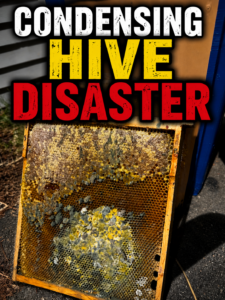
This winter I ran an experiment that failed – I had a single peaked roof hive set up as a currently trendy condensing hive – a single open entrance, no top vents and a ton of insulation on top.
In my case I chose an artificial non-breathing double reflectix as an additional top insulation.
Big mistake!
At first, I counted this colony among my winter survivors but they did not survive for long – the moisture buildup was excessive.
The honey reserves on brood frames got moldy and the queen soon died and the colony collapsed.
After all, how long can bees survive on spoiled food?
Many conventional beekeepers who use chemical or acid mite treatments and sugar-feed their bees embrace condensing hives as sugar stores don’t mold as easily under high humidity.
But in my treatment-free apiary, the bees winter only on their own honey.
It’s natural beekeeping, so I never exchange my bees’ honey for sugar.
I harvest only part of the surplus honey, freeze a good portion of their honey frames, and gradually return those frames in early spring.
That system worked for my other colonies.
But not here.
So now I’m getting rid of this non-breathable Reflectix insulation.
No more condensing hive Kool-Aid for me.
Condensing hives were popularized by a sugar-feeding beekeeper in Yukon and later became trendy in Alaska – regions where overwintering often requires heavy human intervention.
In fact, in Alaska most beekeepers still euthanize colonies before winter and replace them with new bees in spring.
In the video I show the winter setup that consistently works in my area:
A tight bee nest topped with a breathable burlap pillow with raw sheep wool inside.
Now, condensing hive theory often points to natural tree hollows:
thick insulation, stable temperatures, and elevated humidity.
But a real tree cavity is still breathable and moisture-absorbing.
Wood buffers moisture.
Reflectix does not.
A natural colony may tolerate small damp pockets, but if the entire honey reserve becomes moldy, that colony is unlikely to survive for long.