
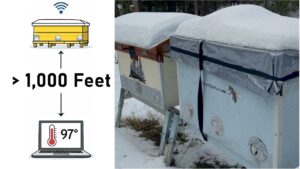
How are the bees doing — not just in winter, but all year long? At my Forest Beehive Apiary in central Maine?Remote Temperature Monitoring setup discussed in the video:
1. https://amzn.to/4pXjXak YoLink Hub, 1/4 Mile Super Long Range Smart Hub LoRa Enabled
2. https://amzn.to/45cH08L YoLink Smart X3 Version Outdoor Temperature Data Logger with Probe, Thermometer, 1/4 Mile Range, 5+ Years Battery Life
(Affiliate disclosure: As an Amazon Associate, I earn commissions from qualifying purchases.)
My hives are not clustered together. They are intentionally spread out, some hundreds of feet apart, in a layout that better reflects how honey bees live in nature. This sparse placement helps limit drift, robbing, and the sharing of parasites and pathogens — a critical foundation for treatment-free beekeeping. And, of course, what helps with treatment-free (TF) beekeeping.
I keep varroa-resistant bees, in my case: certified RHBA/USDA-certified russian bees. What also helps a lot with treatment-free / sugar-free beekeeping is that my ForestBeehive apiary is relatively secluded, bordering a 2,500 acres of wildlife protection sanctuary and far enough away from other beekeepers and far from industrial & agricultural pollution.
I also keep very few hives, in balance with the locally available natural forage. Because my limited number of colonies here have sufficient natural forage from spring through fall, I am able to avoid sugar feeding entirely.
Bees winter on their own naturally foraged honey — real food with real nutrition — not sugar or other artificial substitutes that can stress their digestive systems and contribute to gut diseases.
This video shows a non-invasive, all-season method for monitoring colony health by tracking hive temperature trends over time In winter, I do one simple visual check is the snow in front of the hive.
A few dead bees on the snow can be a good sign — evidence that the colony is alive and there’s no evidence of gut diseases: no yellowish liquid feces around the hive is also important, indicating healthy guts and proper wintering. But snow can only tell me that a colony is alive. It can’t tell me how well the bees are doing. That’s where temperature monitoring comes in.
The goal of my temperature monitoring is not to measure the exact cluster-core temperature. What matters to me are the patterns: stability, sudden drops, and seasonal changes such as the start of spring brood rearing.
Most hive temperature systems today rely on Bluetooth. Bluetooth is a short-range signal that can work in apiaries with tightly clustered beehives, but it breaks down in natural, spread-out setups like mine. Closely clustered hives are convenient for the beekeeper, but bad for the bees: they increase drift, robbing, and disease transmission between colonies. Because my hives are intentionally spaced apart, I cannot use a short-range Bluetooth signal but, instead, I can use long-range LoRa temperature sensors. (LoRa is a newer protoco – it stands for Long Range).
My outdoor-rated sensors communicate over distances of more than a thousand feet with a single central hub, which, in turn, connects to Wi-Fi. Each sensor checks temperature regularly and produces a continuous graph that I can monitor remotely — even when I’m not physically at the apiary. This allows me to check on my hives year-round, across seasons, without opening hives or stressing the bees. It’s a monitoring approach that supports natural forage, low hive density, minimal disturbance, and treatment-free beekeeping. About https://ForestBeehive.com Apiary Central Maine -based treatment-free (TF) apiary using horizontal Layens hives, natural forage without supplemental sugar-feeding, sparse hive placement, and minimally invasive beekeeping, letting bees live as bees.